TRAINING: AUG 1-4 | KENNEL CLUB: AUG 5-6
Black Hat USA 2026 Learn. Connect. Engage.
Connect at Black Hat USA to stay ahead of critical identity and cybersecurity risks. Join us for talks and training on new tradecraft and industry-leading research that will keep you ahead of the latest AI attack modalities and current with the latest in OpenGraph and Attack Path Management practices. Watch this space for program updates.
Black Hat 2026 at-a-glance
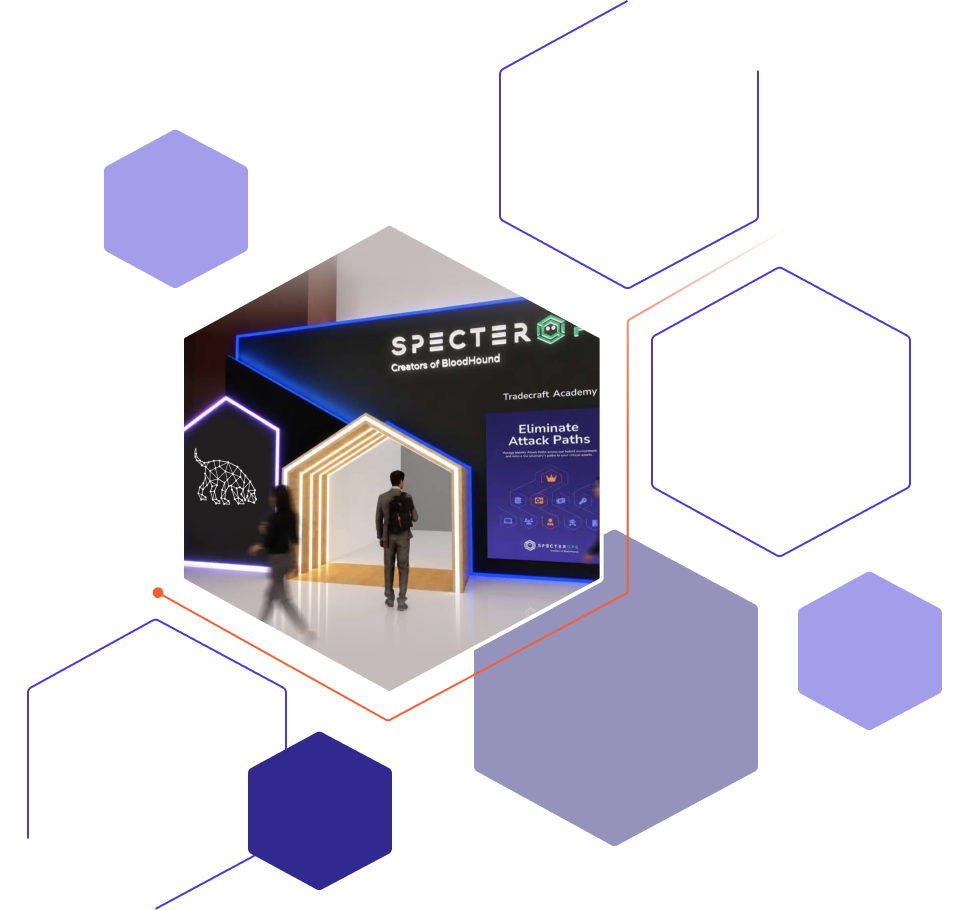
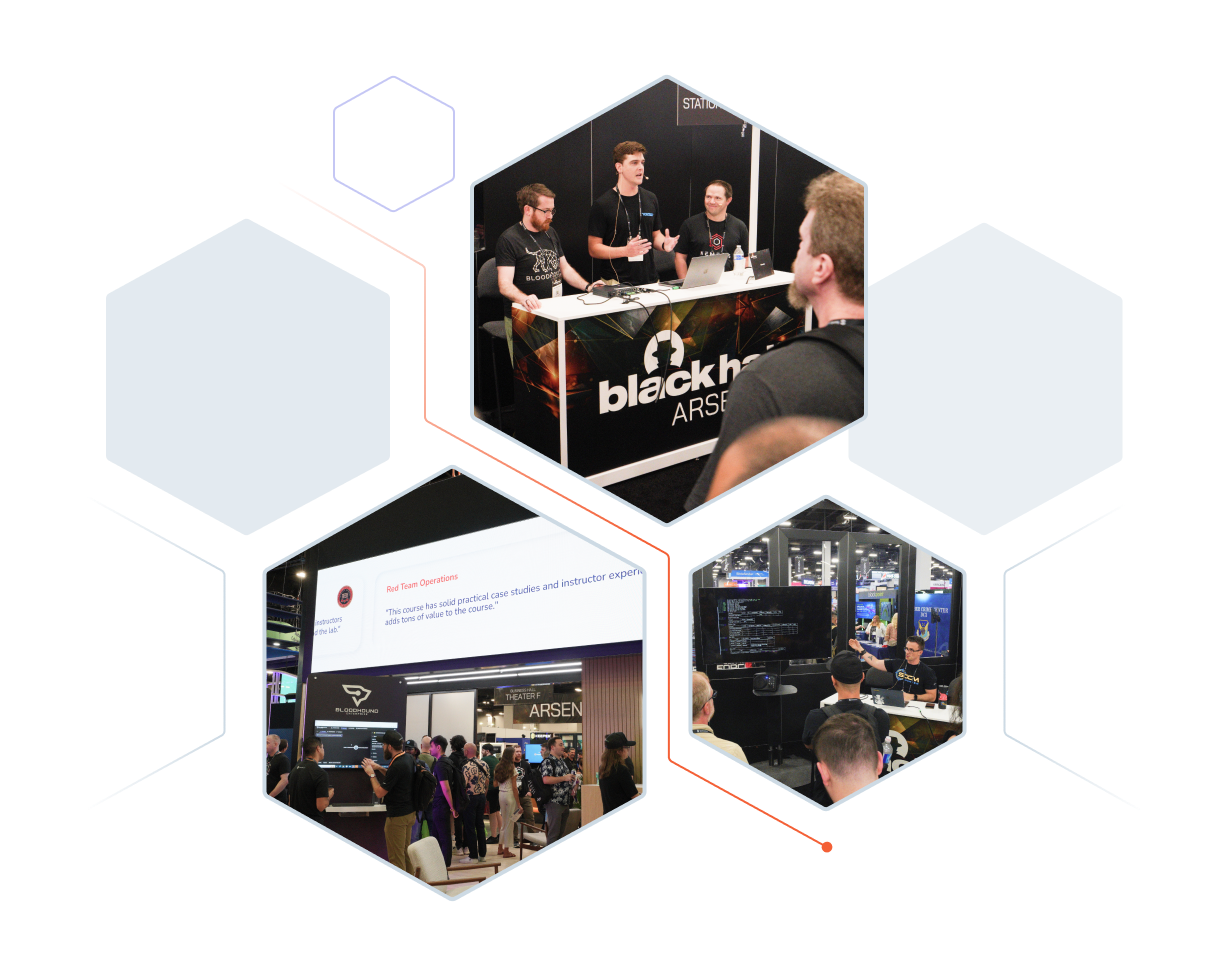
SpecterOps will be front and center across Black Hat this year, highlighting advances in tradecraft, research, AI-driven and hybrid attack paths, as well as BloodHound and OpenGraph. Learn and grow your adversarial skills with official Black Hat trainings. Visit our talks in Black Hat Arsenal. Meet up with researchers, innovators, and expand your Attack Path Management practice at our Kennel Club.
Kennel club
Learn the latest in adversary tradecraft at the SpecterOps Kennel Club
Join fellow identity and security-minded leaders and professionals at Kennel Club, a space designed to share knowledge and mingle with SpecterOps and the security community.
TRAININGS
Adversarial Training at Black Hat
SpecterOps researchers discover the attack paths that define the next wave of threats, and we’re bringing that research into the classroom at Black Hat USA, Aug 1–4.
Join us!
Adversary Perspectives: Azure
See Azure and Entra ID the way attackers do. Learn to identify the misconfigurations and attack paths that matter, and take your first step in attacking or defending corporate cloud environments.
Adversary Tactics: Identity-driven Offensive Tradecraft
Identity-driven attacks remain one of the most critical attack vectors in modern environments. This advanced course covers the full methodology for discovering and abusing identity attack paths across on-premises and hybrid environments.
Adversary Tactics: Red Team Operations
Practice adversary tradecraft in an enterprise-scale lab while learning how your actions surface to defensive teams. This course doesn’t just teach you how to attack — it teaches you how to think, adapt, and operate under pressure.
Adversary Tactics: Tradecraft Analysis
Your detection tools have gaps. So do your evasion strategies. This course teaches you to find both. Deconstruct Windows tradecraft using NtObjectManager and IDA, map the telemetry, and build coverage that holds up against sophisticated adversaries.
Black Hat Briefings from SpecterOps
Trusted Systems and the Future of Attacks.

Adam Chester
Beam Me Up, Luke: A Review of Teleport Attack Scenarios
Traditional network perimeters are disappearing with the increased adoption of cloud infrastructure, SaaS applications, and remote workforces. As a result, solutions such as Teleport have emerged to provide secure access to distributed infrastructure and services, including emerging AI-driven access patterns. But what happens when a threat actor targets the very technology responsible for guarding remote access?
This talk explores the intersection of newly identified vulnerabilities and misconfigurations within Teleport, with a focus on the practical steps that can be taken when assessing environments that rely on it.
I’ll walk through the major components of a typical Teleport cluster deployment and how this differs from other zero-trust access services, laying the foundation for exploring potential weaknesses. Next, I’ll focus on post-exploitation scenarios that may arise during an assessment, from access to an endpoint, to attack-paths available from a compromised Node. In addition, I will provide details of several newly discovered vulnerabilities in Teleport, focusing on their practical use in attacks against a cluster.
By the end of this session, both offensive and defensive teams will have a clearer understanding of weaknesses in Teleport deployments, vulnerabilities in core areas of the platform, and the tooling and knowledge needed to support further research.
Wednesday, August 5 | 4:30 – 5:10 PM
Oceanside D

Michael Grafnetter
Pass-the-Passkey Family of Attacks
Coming from the field of enterprise security, performing privilege escalation and lateral movement by attacking Windows Integrated Authentication is our bread and butter. But as more and more companies are adopting cloud services, we decided to shift our attention to Passkeys, which are slowly but steadily becoming the norm. Surprisingly, our novel research has shown that some implementations of Passkey authentication are vulnerable to attacks fundamentally similar to Pass-the-Hash and NTLM Relay. We have therefore decided to call this category of attacks Pass-the-Passkey.
We have identified the Passkey implementation in a major cloud service to be vulnerable to the attacks the solution was designed to prevent. Moreover, we have discovered past signatures generated by YubiKeys being stored in cleartext form readable by authenticated unprivileged users, even remote ones. This chain of vulnerabilities allowed us to successfully impersonate privileged users while bypassing the enforcement of phishing-resistant MFA and remaining undetected by popular XDR solutions.
The tooling we developed to exploit these vulnerabilities can also be utilized to perform Passkey phishing, tampering, spoofing, fuzzing, and prompt flooding attacks. Some of these techniques can even be executed on compromised terminal hosts and/or virtual machines to which target identities are connecting. We will demonstrate the feasibility of these attacks using a popular C2 infrastructure.
As the WebAuthn specification mandates a 22-step Passkey validation process involving non-trivial cryptography and transactional processing, making a mistake while implementing the spec is easy, even for companies that co-authored the standard. We expect that by open-sourcing our tools, we will enable other penetration testers to discover many more web application vulnerabilities stemming from non-compliant Passkey verification procedures.
Wednesday, August 5 | 3:35 – 4:15 PM
South Seas CDF

Beyviel David
Turning Enterprise Update Servers Into Backdoor Factories (0_o)
Windows Server Update Services (WSUS) sits at the heart of enterprise patch management, responsible for distributing updates across thousands of endpoints. Its privileged position in the network makes it a high-value target. A compromised WSUS server enables lateral movement, persistent footholds, and organization-wide implant deployment at scale.
This Briefing presents original research into a new Attack Path technique that results in full WSUS infrastructure takeover. We will walk through how security infrastructure itself can be weaponized, how existing controls can be bypassed, and how malicious update packages can be deployed for domain-wide code execution.
Attendees will leave with a clear understanding of the attack surface, practical remediation guidance, two new open-source tools, and a five part blog series which will be released alongside this Briefing. Defensive mitigations will be covered giving defenders actionable steps to harden their environments before attackers exploit the same techniques.
Wednesday, August 5 | 10:15 – 10:45 AM
Oceanside B
Talks from SpecterOps experts during Black Hat’s Business Hall
Get inspired and deepen your adversarial knowledge with SpecterOps’ expert researchers during the Arsenal showcase.
Nemesis 2.2
Wednesday, August 5 | 12:30 PM
Arsenal Station 5


Lee Chagolla-Christensen
Ghostwriter
Wednesday, August 5 | 10:10 AM
Arsenal Station 7

Sage: Giving an AI the Keys to Your C2 Framework
Thursday, August 6 | 12:30 PM
Arsenal Station 4

MSSQLHound – Identify, Visualize, and Navigate MSSQL Attack Paths in BloodHound
Wednesday, August 5 | 11:20 AM
Arsenal Station 2


Javier Azofra
ConfigManBearPig – Identify, Visualize, and Navigate SCCM Attack Paths in BloodHound
Tuesday, August 4 | 5:15 PM
Arsenal Station 6
SpecterOps at DEF CON 34
DEF CON is where offensive security practitioners share research, challenge assumptions, and test ideas with the community. Stop by to catch SpecterOps talks, discuss real-world attack paths and identity abuse, and meet the team behind BloodHound, and other tools built from an adversary’s perspective.

JD Douillard
BloodHound OpenGraph Crash Course
In this session, attendees will learn how to design data models and build extensions for BloodHound OpenGraph.
After a presentation where I will go over the core concepts & components of BloodHound OpenGraph and the thought process behind BloodHound data modeling, attendees will design a model and build an extension from scratch based on a provided dataset.
If you like to tinker with BloodHound and are curious about the new OpenGraph features, this session is for you…
Note: Bring your own laptop with BloodHound Community Edition installed
Time: TBD
Red Team Village

Steven Flores
A Provider for the MOFia – Distributed Post-Ex Capabilities
For over a decade, offensive use of WMI has been largely confined to Win32_Process for remote execution and event subscriptions for persistence. Defenders and EDR vendors have optimized accordingly and the offensive community has moved on, treating WMI as a solved, well-monitored space.
This research demonstrates that WMI providers represent an entirely unexplored post-exploitation execution plane. We show how to remotely install custom WMI providers on target hosts by reimplementing the mofcomp.exe MOF compilation and installation process entirely over pure WMI parsing MOF files locally and pushing provider registration through the MS-WMIO binary protocol specification. No files are dropped via SMB. No WinRM. No agents. No implants. Every byte of data travels over DCOM/RPC as native WMI traffic.
We present novel techniques for uploading and downloading files over pure WMI using existing Windows classes methods that have not been previously documented or abused by threat actors. Combined with remote provider installation, this creates a fully distributed post-exploitation capability: remote .NET assembly execution, BOF execution, position-independent code execution, Kerberos ticket triaging, and remote process dumping that was tested against major EDR products with minimal alerts generated across multiple red team engagements. We will release an open-source toolkit including remote provider installation tooling, a library of post-exploitation providers, and an operator interface for interacting with deployed providers on remote hosts. Defenders will leave with concrete detection guidance for identifying WMI provider abuse because right now, most aren’t looking
Time: TBD
Location: TBD

Nick Powers
MSIX's Up: Weaponizing the Modern Windows App Packaging Ecosystem
What happens when the ecosystem Microsoft built for isolation and integrity of modern Windows applications becomes a foundation for novel attacker tradecraft?
For over 13 years, an ecosystem that includes MSIX, UWP, AppContainers, package identity, and the Windows Runtime has shipped by default on modern Windows. Yet offensive research into this ecosystem remains scarce, and visibility into its abuse lags further behind.
In this talk, we demonstrate novel techniques spanning all major parts of an attack path.
For initial access, we abuse URL protocol handlers and packaging file formats to subvert endpoint detections. For post-exploitation, we overcome AppContainer process isolation to operate beneath EDR visibility thresholds. For lateral movement, we expose previously unabused WMI providers and DCOM objects within package installation services. For privilege escalation, we chain a logic flaw in package capabilities to achieve SYSTEM from a standard user context.
Every technique requires no third-party software, works on fully patched systems, and abuses default-enabled features. We release tooling for red teams alongside detection guidance for defenders.
The modern app packaging ecosystem was designed for isolation and integrity. We used its design to our advantage and turned it into an attack platform.
Time: TBD
Location: TBD

Shad Brown
Automated Mythic Deployment with Gaia
Deploying a C2 server manually is a time consuming, sometimes annoying process. Deploying a C2 server weekly for two months, even more so. This Tactic will cover Gaia, the tool developed by the Midwest Collegiate Cyber Defense Competition Red Team to handle automated C2 deployment, user provisioning, payload creation, and more.
This Tactic will have attendees start with a standard Debian VM, and end with a fully provisioned Mythic server that can serve as the foundation for your next CTF, lab, or with a little extra work, your next op.
Time: TBD
Red Team Village

Hugo van den Toorn
BloodHound Quest at Red Team Village
Join our BloodHound Quest at the Red Team Village during DEF CON 34 (August 7–8) and put your BloodHound knowledge to the test in a fast-paced digital scavenger hunt.
This isn’t your typical CTF. There are no exploits to write, shells to pop, or buffers to overflow. Instead, you’ll solve challenges by exploring, investigating, and thinking like an operator. Whether you’re a seasoned BloodHound user or just getting started with attack path analysis, there’s something here for you.
You’ll only have two hours.
Most players won’t finish. That’s by design.
There are more challenges than anyone can reasonably complete, so success isn’t just about what you know. It’s about how you prioritize, adapt, and make decisions under pressure. The leaderboard is live, the clock is ticking, and every point counts.
What you’ll need
Bring a laptop. A burner is perfectly fine, given the environment.
How to play
- Stop by the Red Team Village.
- Grab the event code.
- Head to begin.bloodhound.quest to sign up.
- Start hunting.
The loot
Besides a good time and bragging rights, the top-ranking players will win a SpecterOps training seat of their choice.
Our courses are hands-on, in-depth and built by the same Offensive Security experts who created BloodHound and continue to drive the research behind it, making this a prize well worth competing for.
Winners must be physically present at the Red Team Village to claim their prize.
Need help during the game? Join #BloodHound-Quest in the BloodHound Slack at community.specterops.io, or find a SpecterOps team member on-site.
Come play. Climb the leaderboard. See where you rank.
Time: TBD
Red Team Village

Featured Talk
Pass-the-passkey Family of Attacks
Michael Grafnetter
Researchers identified a new class of attacks called “Pass-the-passkey”, allowing attackers to impersonate users, bypass phishing-resistant MFA, and evade detection. Risk factors include flaws in Microsoft’s implementation of passkey authentication, malware, or MFA fatigue.
Wednesday, August 5 | 3:35 – 4:15 PM
South Seas CDF
Join us for happy hour!
Brooklyn Bowl
3545 South Las Vegas Boulevard, Las Vegas, NV 89109
Wednesday, August 5, 2026 | 6:30 – 10:30 PM